












The largest global analysis of plant–pollinator interactions overturns a long-standing ecological expectation and reveals climate as the main force shaping pollination around the world. A major international study led by researchers from Charles University in Prague (CUNI) and the Biology Centre of the Czech Academy of Sciences (BC CAS) has mapped how closely flowering plants and their pollinators depend on each other. Published in Nature Ecology & Evolution, the study shows that climate is the main force behind these patterns, a finding that challenges the classic expectation that pollination becomes more specialised towards the tropics.
Much of the green world depends on animals carrying pollen from flower to flower. Pollination enables plants to reproduce, maintain genetic diversity, and produce fruits and seeds that feed countless animals. Flowers, in turn, provide nectar and pollen that sustain an astonishing variety of pollinators. Bees may be the best known, but flies, beetles, butterflies, moths, wasps, and even birds and lizards also fill that role. Our own food supply relies on these partnerships, particularly for many fruit, vegetable, nut, and oil crops.
Many plants have specialized relationships with particular pollinators, while others are visited by a range of generalist insects. Many ecologists expect that specialized pollinator-plant relationships are more common in tropical areas due to the greater numbers of interacting plant and animal species there. But this assumption of a latitudinal gradient in specialization remained largely untested due to a lack of appropriate data.
“Specialisation can be understood as an evolutionary bargain. A close match can make feeding and pollination very efficient, but it also increases dependence. If one partner disappears or becomes active at a different time, a specialist has fewer alternatives,” explains the study’s lead author Sailee Sakhalkar, who recently completed her doctorate at CUNI.
To find out whether the specialised partnerships are indeed more common in the tropics, researchers brought together 3,415 plant–pollinator networks from 162 studies. The dataset contained more than 110,000 links among 5,343 pollinator and 6,126 plant species from all major terrestrial biomes, from tropical forests and savannas to Mediterranean shrublands, temperate forests and meadows, and subarctic tundra. The study brought together 142 researchers from 32 countries across six continents, and represented years of fieldwork around the world.
“No single team could study pollination on this scale,” says Sakhalkar. “By combining the work of researchers from across the world, we could finally see both the global picture and the enormous variety within it.”
The surprising result was that more specialised ecological relationships were not more common in the tropics. While specialization often reached its highest levels near the northern boundary between the tropics and subtropics, each group of plants and pollinators followed their own patterns. Moreover, rather than latitude, the researchers found that temperature and rainfall better explained global patterns in specialisation, and the effects differed greatly among pollinator groups.
“We tend to draw geographical patterns in pollination as lines running from the poles to the equator, but plants and pollinators do not experience latitude itself. They experience heat, cold, rain and changing seasons, each in their own way,” says Robert Tropek, head of the Insect Community Ecology Research Group, who jointly led the study at the Faculty of Science CUNI and BC CAS.
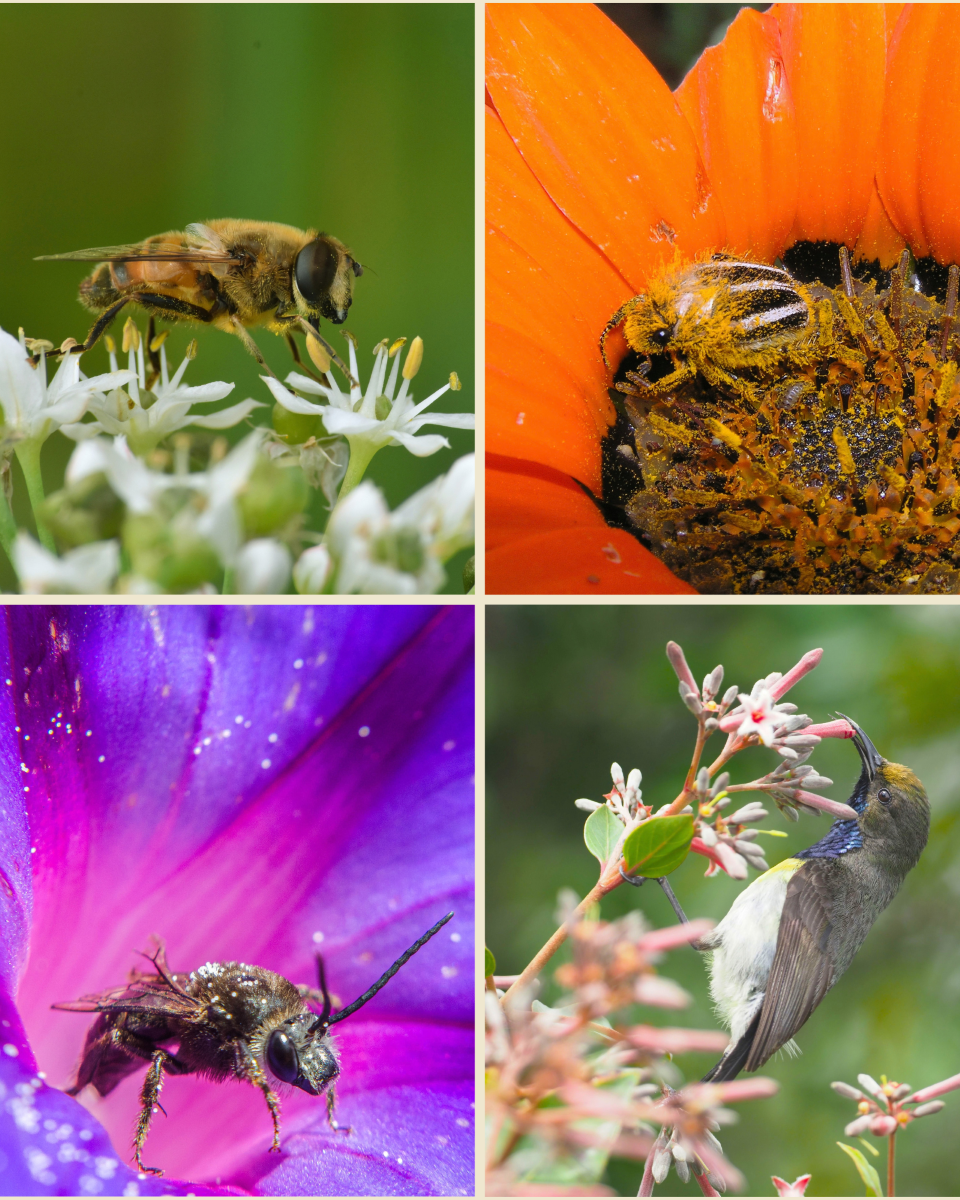
Pollinators on their flowers, clockwise from top left: drone fly (Eristalis tenax) foraging on garlic chives (Allium tuberosum) in Czechia; monkey beetle dusted in pollen on Gazania daisy in South Africa; Newton's Sunbird probing red cinchona (Cinchona pubescens) flowers on São Tomé; and wild bee (Thygater) visiting shrubby fuchsia (Fuchsia paniculata) in Guatemala. Credits: J. Jersáková, T. Hájek, Š. Janeček, and A. Mejía Coroy, respectively.
These findings are relevant to how plants and animals will respond to a changing climate, which will also likely affect crop production, particularly crops with specialized pollinator relationships. Rising temperatures and altered rainfall can change where species live, when plants flower, and when pollinators are active. They can therefore redraw the map and calendar of encounters between plants and pollinators.
“A bee, hoverfly, moth, and hummingbird differ substantially in their bodies, behaviour, and ways of using flowers. Their relationships with plants may therefore respond very differently to changes in temperature and rainfall,” says Sakhalkar. “Recognising these differences is essential if we want to understand which pollination systems may be most vulnerable to climate change.”
“Climate change is unlikely to alter every pollination network in the same way,” Tropek adds. “In many places, plants may be vulnerable to the loss of their specialized pollinators, leading to lower fruit set and declining populations. The risks may be particularly high in the most specialised communities. If a plant or pollinator depends on only a small number of partners, the loss of even one due to the changing climate may be difficult to compensate for. More flexible species, in contrast, may be able to switch to other partners.”
Full study reference: Sakhalkar et al. (2026) Global patterns in plant–pollinator specialization. Nature Ecology & Evolution.
https://doi.org/10.1038/s41559-026-03170-7